

18 May 18th May 2026
Markets Year to Date
| S&P500 | +8.2% |
| Nasdaq | +14.4% |
| Aussie ASX200 | -2.4% |
You are probably aware that the Nasdaq exchange is chock full of tech companies. In the late 1990s retail investors were already flocking to the exchange to buy the latest and greatest tech companies, but they didn’t know which one to buy. The Nasdaq wanted to make it easier for retail customers to access their products.
This is a quote from John Jacobs, then head of strategic planning:
“We wanted to put investment and trading products in the hands of investors that were Nasdaq-branded,” ………. “You didn’t have to pick a Nasdaq stock – you could pick a basket of Nasdaq stocks.”
The Nasdaq 100 index tracking stock was launched in March 1999. It was an immediate hit. Listed under the ticker QQQ. It accumulated $12billion in assets in its first year. Five years later trading volumes had increased to 100million shares a day and a million investors held it.
As it grew the Nasdaq exchange realised this was outside their main capabilities so transferred the asset to PowerShares. They had 400 sales people. The Nasdaq had 3. It was easy math to see how they could broaden their distribution.
QQQ now sits on $456billion of net assets, making it the fifth largest exchange-traded fund in the market.
Buying QQQ means you are buying the biggest 100 companies listed on the Nasdaq exchange. Top holdings are
- NVidia
- Apple
- Microsoft
- Amazon
- Broadcom
- Tesla
- Meta
- Walmart
How would you feel if the above was your portfolio? Well it can be. Just buy QQQ
My take on this is – QQQ is the best thing you can buy. You cannot beat it. No amount of stock picking will beat what QQQ does. Why?
Well, firstly in research done by Dr. Hendrik Bessembinder confirms that a tiny minority of stocks drive nearly all long-term stock market gains. A study covering 1926–2022 found that just the top 2.4% of companies (roughly 72 firms) accounted for all net wealth creation, with over 50% of stocks failing to outperform simple Treasury bills.
Do you think you are good enough to pick the 2.4% of companies that account for all the long-term stock market gains?
The second reason is an index will always recover any loss in time. You cannot say the same for an individual stock.
Back inn the year 2000, Cisco (CSCO) was trading at $76. It was a poster child of the tech boom and one of the leading stocks. Then the tech wreck happened and CSCO shares fell. It was only towards the end of 2025 when it made moves towards AI that the stock price exceeded $76 again. Many never recover at all.
But a different thing happens inside an index. The index is weighted by market cap. So companies that do well get pushed up the list and those that do poorly go down the list. This gives the index a natural and internal rebalance to always favour winning stocks.
In a traditional portfolio of individual stocks you need to sell them at some point when their future changes. Or you end up holding a CSCO forever hoping that one day it will recover.
The index does this for you. You don’t need to do anything yourself.
And then you have the returns this things makes.
This chart shows rolling 3-year returns for QQQ. It shows what buying on any random day and holding for a 3-year period would have done for you in the past.
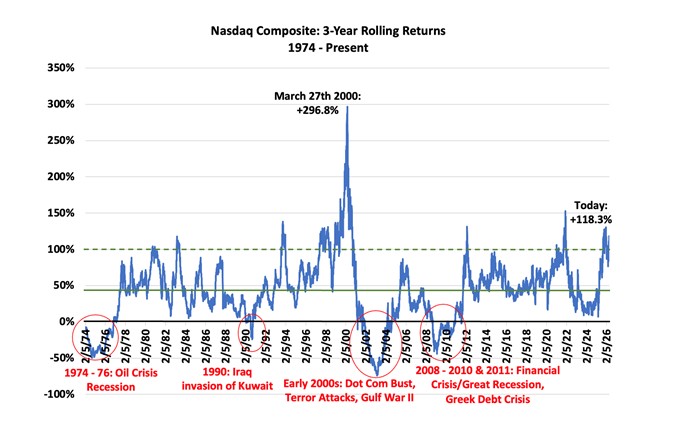
A few things stand out from this data.
- The Nasdaq has rallied by an average of +41.6% over any given 3-year period. That’s a compounded annual growth rate of +12.3%
- Very rarely has the index produced a negative return over a 3-year period. 84% of the time the result is positive.
- We haven’t seen a negative 3-year return for almost 15 years
- The index has doubled in the last 3 years (+118%). But that is a relatively common experience having occurred many times in the last 52 years.
The companies that make up the index has changed significantly in the last 5 decades, but the returns from the index are just as impressive as they always have been. This talks to the fact that markets consistently reward American disruptive innovation across many business and economic cycles.
US tech companies consistently have an edge in building, scaling and sustaining highly profitable and global business models.
Why would you buy anything else?
Warning
Stock values can go down as well as up. It is possible to lose 100% of your investment in a stock. Any advice given by Capital 19 is general advice only and does not take your personal circumstances into account and might not be suitable for you.