

08 Sep 8th September 2026
Markets Year to Date
| S&P500 | +12.8% |
| Nasdaq | +16.0% |
| Aussie ASX200 | +2.4% |
Last time I wrote about Gold.
I got quite a few people asking me, do I buy physical Gold or GDX (gold miners) like you suggested?
Well, personally I prefer Gold Miners (GDX)
A mining company tends to have a stable cost basis. Salaries, depreciation, leases, etc. They are all fairly consistent. Costs are like a flat line
But sales go up and down greatly depending on the price of Gold.
To illustrate this, let’s make up an example. Let’s say a Gold Miner has a cost basis of $100. Gold is selling for $110. Therefore they make $10 per ounce. Their profit margin is 9%.
Gold then increases to $120. The price of Gold goes up 9%
But the Gold Miner now makes $20 per sale. Their profit goes from $10 per ounce to $20 per ounce. Profit margin is now 18%. It has doubled.
So Gold goes up 9% and a Gold Miner profits and profit margins go up 100%.
Now, obviously in the real world it isn’t quite like this but you get the idea.
The flip side of this is – it works the other way too. If the Gold price drops it has a bigger effect on the Gold Miners than it does on Gold.
I also feel I was not clear about the last graph last week. This one
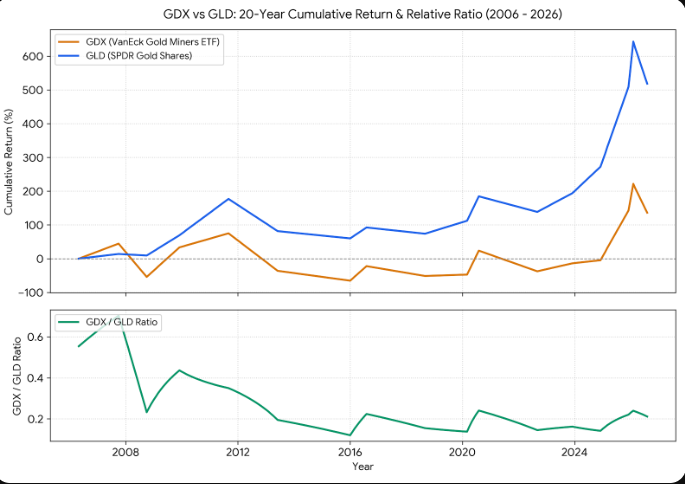
Pay attention to the green line at the bottom. Back in 2008 the ratio of the price of GDX to Gold was 0.6. Now it is 0.20. Mind you it has been like that for a decade or so.
What it says is Gold Miners are out of favour compared to Gold itself. We see this all the time. Markets decide something is no longer “hot” and investors stay away. But these long-term cycles often swing back. And when they do, it can be absolutely explosive.
That was the point I should have made last week.
A final piece of news on Gold. This might seem minor, but I do not think so. It goes to my point in the last CatchUp about foreign countries no longer trusting the US.
The Netherlands have just moved 86 metric tonnes of Gold out of the US and Canada and to London.
Clearly the Netherlands do not think holding their assets on US soil is a good idea. Because anything held there can be seized by the US.
It is probably an over-reaction by the Netherlands. But it shows how the world is changing. Countries no longer trust each other.
It means the old ways of selecting assets will no longer work. We need to adapt
So ignore anything that says, in the past when this gets to this ratio blah blah blah. It no longer applies. We are in a new paradigm.
The year of 2026 has certainly brought a host of unexpected events
A war in the Middle East has Oil trading over $90 a barrel
Concerns about long-term inflation have Bond yields for nearly every country at decade highs.
Against this backdrop you would expect stocks to be struggling. Yet the broad index is up 13% this year. Higher than the average full year of 10%.
How can this be?
Well, it makes perfect sense when you consider just how fast corporate earnings are growing.
I won’t bore you with the maths here, but equity values are a function of future cash flows, divided by the difference between expected equity returns and expected growth in cash flows.
To put it simply, corporate profits are growing faster than interest rates
If they can maintain this differential then share prices will continue to increase.
Remember, from the end of this month, we enter the traditionally best time of the year for share prices.
September holds the title of worst month for equities. The average return is -1.1% for the last 50 years.
But the last 3 months average +4.1% for the same time period.
Any dip we see in the next four weeks is an opportunity to buy and position for Q4
Warning
Stock values can go down as well as up. It is possible to lose 100% of your investment in a stock. Any advice given by Capital 19 is general advice only and does not take your personal circumstances into account and might not be suitable for you.